
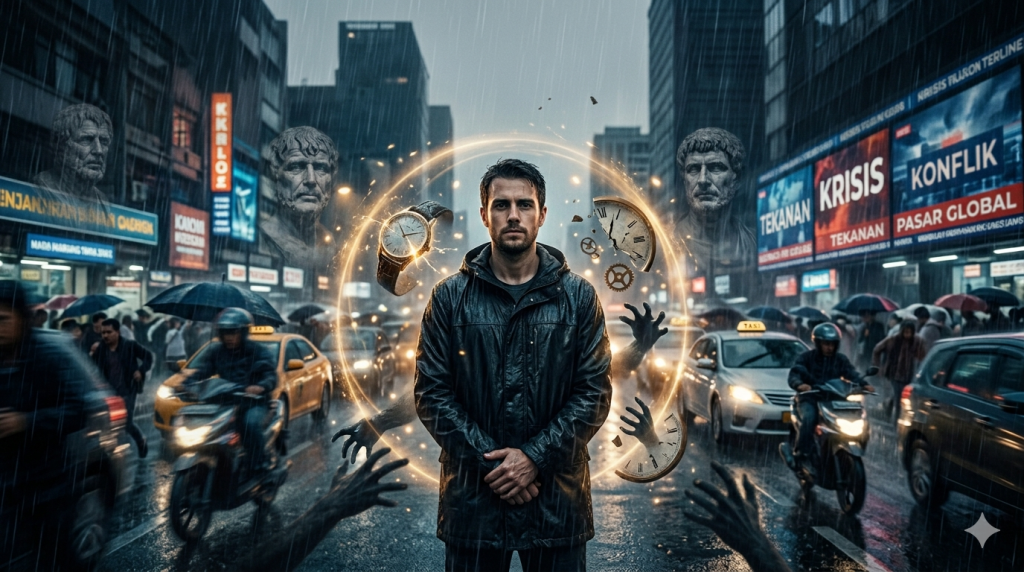
We Can't Control the World... But We Can Control Our Response
Life does not always move according to our expectations. No matter how carefully we plan, unexpected situations still appear without warning. People disappoint us, opportunities disappear, relationships change, and reality often refuses to follow the direction we hoped for. At some point, we are forced to accept one difficult truth: the world is not fully under our control.
Many people spend most of their live trying to control things outside themselves. They want to control outcomes, other people’s opinions, future events, and every situation around them. However, the more we try to force control over things we cannot truly manage, the more eshausted we become emotionally. The problem is not weakness, but misplaced focus. We are investing energy into things that were never ours to control in the first place.
Stoic philosophy discusses this idea through a concept known as the dichotomy of control. Philosophers such as Epictetus explained that life can be divided into two categories: things we can control and things we cannot. Our thoughts, choices, attitudes, and responses belong to us. External events, other people’s actions, and the future itself do not. Much of human suffering begins when we fail to separate these two things.
For example, when someone insults us, we cannot control what they choose to say. We cannot force every person to understand or respect us. However, we still have control over how we respond. We can react impulsively with anger, remain calm, ignore the insult, or even learn something from the experience. In that moment, our real power is revealed—not through controlling others, but through controlling ourselves.
Many people do not realize that response is a choice. Emotions often feel automatic, as if they completely take over the mind. Yet between every event and every reaction, there is always a space. Psychiatrist Viktor Frankl wrote about this idea in Man’s Search for Meaning, explaining that within that space lies our freedom and our power to choose our response. This perspective changes everything. It reminds us that even in difficult situations, we are not entirely powerless.
Once we understand that our response is a choice, life begins to feel lighter. We stop viewing ourselves as permanent victims of circumstances. Instead of blaming the world for every disappointment, we begin taking responsibility for the way we think, act, and respond. This shift creates emotional strength from within.
Many people believe happiness depends on external conditions. They think they will finally feel peaceful once life becomes easier, once people change, or once every problem disappears. The reality is that life will never remain stable forever. Circumstances constantly change, and uncertainty will always exist. If our peace depends entirely on the outside world, then our emotions will endlessly rise and fall with every situation around us.
Mentally strong people understand something different. They realize that stability must be built internally. Rather than waiting for life to become perfect, they train themselves to respond wisely to imperfect situations. Their strength comes not from controlling life, but from learning how to navigate it calmly.
The Roman emperor and Stoic philosopher Marcus Aurelius once wrote, “You have power over your mind—not outside events.” Although simple, this statement contains profound wisdom. It reminds us that true control is found within ourselves, not in the world around us.
Controlling our response does not mean suppressing emotions or pretending to feel nothing. Emotional strength is not emotional numbness. Instead, it means becoming aware of our feelings, understanding them clearly, and choosing thoughtful action instead of impulsive reaction. We are still human—we will still experience anger, sadness, disappointment, and frustration. But those emotions do not have to control our behavior.
Modern psychology supports this idea as well. Cognitive Behavioral Therapy (CBT), developed by Aaron T. Beck, explains that thoughts influence emotions, and emotions influence behavior. The way we interpret a situation affects how we emotionally respond to it. Because of this, changing perspective can also change emotional experience.
For example, failure can be interpreted in two completely different ways. One person may see failure as proof that they are incapable or worthless. Another person may see it as part of growth and learning. The same event can create entirely different emotional outcomes depending on interpretation. This is why perspective holds such power in human life.
Of course, learning to control our response is not easy. It requires awareness, patience, and consistent practice. Human beings naturally react emotionally under stress and pressure. However, self-reflection allows us to slowly break unhealthy patterns and develop greater emotional maturity.
One simple habit that helps is asking ourselves reflective questions after emotional situations: “Why did I react that way?” or “Was my response helpful?” Questions like these increase self-awareness and help us respond more consciously in the future.
There is also social pressure that makes emotional control difficult. Some people believe that reacting aggressively is a sign of strength. In reality, remaining calm during emotional situations often requires far greater strength than impulsive reaction. The person who can pause, think clearly, and choose their response carefully is often the strongest person in the room.
In daily life, we can practice this mindset through small moments. Traffic jams, criticism, misunderstandings, disappointment, and unexpected problems all become opportunities to train emotional awareness. The goal is not perfection, but consciousness.
Over time, wise responses begin to appear more naturally. We become less reactive and more intentional. Instead of responding immediately to everything around us, we create space between the event and our action. Within that space, we discover self-control.
It is also important to realize that not everything deserves a response. Sometimes silence is wiser than argument. Not every battle needs to be fought, and not every opinion deserves our attention. Emotional discipline means understanding where our energy should and should not go.
Life will always contain uncertainty. Problems, setbacks, and disappointment are unavoidable parts of being human. Yet uncertainty often reveals character more clearly than comfort ever can. Our true strength is not shown by what happens to us, but by how we choose to handle it.
When we stop trying to control everything outside ourselves, life becomes lighter. We stop exhausting ourselves over things beyond our reach. Instead, we focus on our mindset, actions, and decisions—the things we can actually influence.
In the end, true strength is not about controlling the world. It is about learning how to manage ourselves within a world we cannot fully control. While we may never control every situation, we will always have the ability to choose our response.
And perhaps that is where peace truly begins.
-Kasim-
References
Epictetus. (2008). Enchiridion (N. P. White, Trans.). Hackett Publishing Company.
Frankl, V. E. (2006). Man’s Search for Meaning. Beacon Press.
Holiday, R. (2014). The Obstacle Is the Way: The Timeless Art of Turning Trials into Triumph. Portfolio.
Irvine, W. B. (2009). A Guide to the Good Life: The Ancient Art of Stoic Joy. Oxford University Press.
Marcus Aurelius. (2002). Meditations (G. Hays, Trans.). Modern Library.
Beck, A. T. (1976). Cognitive Therapy and the Emotional Disorders. International Universities Press.